DRC eVisa for Sao Tome and Principe Citizens
In case you are a citizen of the country of origin which is the São Tomé and Prinoce and you propose to visit the Democratic Republic of Congo (DRC), you are at the right place. DRC is an interesting destination with a rich cultural experience and breathtaking landscapes. A visa is necessary before travelling and, fortunately, DRC eVisa Sao Tome and Principe Citizens, making it easier. Here all the information regarding DRC eVisa application, required documents, timeframes, and tips that will help you cope with the journey are provided.

How long does it take to get a visa for the DRC?
The DRC eVisa processing time of the citizens of the Republic of the Island of Saint Tomae and Princip is dependent on the urgency of the application. Processing options are three in number:
- Normal Processing: This is a process that takes 11-13 days of work.
- Rush Processing: In case you require the visa in less time, this is done within 8-11 working days.
- Super Rush Processing: This is the quickest process that will submit your eVisa in a 5 to 8 days working period.
You should make the arrangements way before you are due to move so that you will not run out of time to get your visa.
What documents are needed for a visa application?
To facilitate the process of application, you must make sure that you possess the following required documents for Congo visa:
- Passport Bio Page: Should have 6 months validity coming to arrival with clear bio page.
- Recent Photo: A white-background color image.
- Application Letter: Letter of brief description of the purpose of your trip.
How to apply for a DRC visa?
The process of applying to the DRC eVisa on behalf of the citizens of the Republic of Tome and Principals is a simple one. The following is also a step-by-step guide to navigate the application:
- Complete the Visa Application: Fill in the visa application on the platform DRC eVisa and enter personal, travel, and passport information.
- Upload Documents: Upload your bio page of the passport, a recent passport photo, and an application letter.
- Pay the Visa Fee: Pay the Visa Fee with a secure method and that is usually by credit card.
- Wait to Be Approved: Your visa will be processed by DRC authorities and you will get an email confirmation on that.
- Download and Print: Once approved, you can download and print your eVisa and present the same on arrival.
How much does a DRC visa cost?
The DRC visa fee is further divided into two components:
- Visa Cost: This is the fee that you are not refunded when you use the Congolese authorities to process your visa application.
- Service Fee: This is an extra charge of visa agencies to the applicants in aid of the process and documents verification and support.
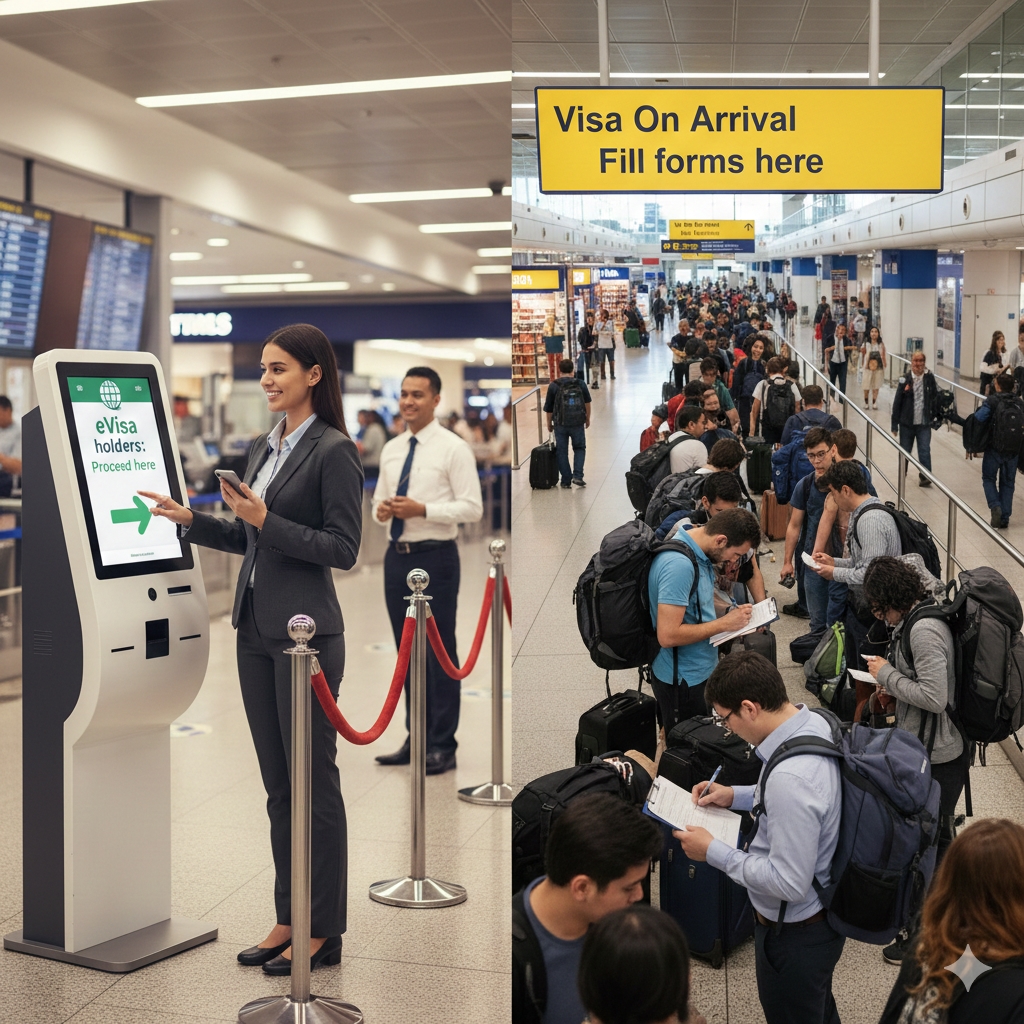
What is better, eVisa or visa on arrival?
Travelers visiting the DRC are always faced with the choice of whether to select an eVisa or visa on arrival. The two alternatives are both entry enabling, but with various pros and factors. We will divide them to assist you in making the most valuable decision in your trip.
eVisa:
- On-time: Book online prior to travelling.
- Time-Saving: By-Pass the lines.
- You can be sure that you will get smoother entry when you have your visa approval beforehand.
Visa on Arrival:
- Flexible: Use at the border or airport in case you change your mind and want to travel last-minute.
- Uncertainty: Delays or possible refusal of entry, and might demand additional documents.
- Lack of Availability: This option may not be available in all travelers or entry points.
The eVisa is usually more preferable to a smoother and predictable experience, whereas the visa on arrival gives flexibility but with a higher amount of uncertainty.
What is the Payment Method in Congo?
In traveling to the DRC, one will normally pay in US dollars. The DRC is located in the Congolese Franc (CDF) although most transactions are made in the US dollar especially at the urban centers. Once you are in the country, you can change your money in banks or the exchange points.
What is the Main Currency of Congo?
Congolese Franc (CDF) is the currency of the Democratic Republic of Congo. Nevertheless, as previously stated the US dollar is also widely used and accepted, particularly in major cities like Kinshasa and Lubumbashi.
When you are visiting the more distant localities, you will find it well to have your money exchanged to Congolese Francs prior to your departure. ATM is availed in large cities but it is not always easy to access it in rural areas.
How do people access the Internet in Congo?
In the DRC, internet connectivity is also getting better but it remains patchy in certain regions especially outside some major cities. The mobile network and Wi-Fi hotspot in hotels, restaurants and cafes are reliable in bigger cities such as Kinshasa. Nevertheless, the rural regions might not have access to the internet.
In order to remain in touch, most tourists choose a local SIM card, which is available in the airport and in the local mobile shops. Before booking into a hotel or any other place to stay, it is always better to enquire with the hotel or accommodation in terms of whether it provides Wi-Fi or internet services.
Can you drink alcohol in Congo?
Yes, we do have alcohol in DRC and it is usually taken in social places. The local beers like the Primus and Turbo King are also in demand. International spirits and wines are also available in the bigger cities.
But one should drink responsibly and must be aware of the local traditions and regulations. It is not a good idea to be drunk in the street, and it is better to consider cultural peculiarities of the drinking.
What are the main differences between applying for an e-Visa via an agent and through the government website?
An e- Visa is an electronic travel permission of short-term travel, e.g. tourist or business travel. In the case of Congo it is applicable via the government site, such as congo-evisa.com.
Applying through the Government Website:
- Slow Government websites may be slow, particularly during peak seasons and might experience delays and glitches.
- Weak Support: Customer support can be unresponsive or difficult to access when it is needed urgently.
- Difficult Interface: Government sites may be overly complicated and hard to navigate particularly when it comes to complicated visa applications.
Applying through an Agent Website (e.g., congo-evisa.com):
- Simple Interface: Agent websites are also user friendly and therefore the process is fast and simple.
- Customer Support: They have a responsive customer support through live chat, phone or email in case of any problems.
- Quick Processing: You can also have expedited services which have you receive your e- Visa faster but at a higher cost.
- Convenience: Most websites will complete information and make it easier, which is perfect in the case of a first-time applicant.
- Various Services: There are several agents that will provide other services including hotel reservations or taxi services.
Is it safe to go to DRC right now?
The areas you intend to visit will determine how safe it is to travel to the DRC. While some places, particularly in the country's east, may be more vulnerable to political unrest and security concerns, cities like Kinshasa and Lubumbashi are usually safe for visitors.
Checking travel advisories from reputable sources, such as international organizations, is always an excellent approach to stay updated. For a safer and more pleasurable experience, it's also advised to join organized tours or employ local guides.
Conclusion
For citizens of São Tomé and Príncipe, the DRC eVisa is a great method to make travel to the DRC easier. You may tour this dynamic and diverse nation with ease if you follow the application process and make sure you have all the necessary paperwork. The DRC has a lot to offer whether you're traveling for business, pleasure, or travel.
FAQs
1. With an eVisa, how long may I remain in the DRC?
The Ordinary Flying Visa is valid for up to seven days.
2. Can my eVisa be extended?
The eVisa cannot be extended. If you need to stay longer, apply for a new visa.
3. Do I require documentation of my accommodations?
Although it's not always necessary, having a hotel reservation or invitation letter is beneficial.
4. Can I travel on land with my eVisa?
No, the eVisa is only valid for air travel; if you want to travel on land, you should apply for a different visa.
5. What happens if my eVisa takes longer than expected?
To prevent delays, make sure all information is accurate and seek advice from DRC.
Comments